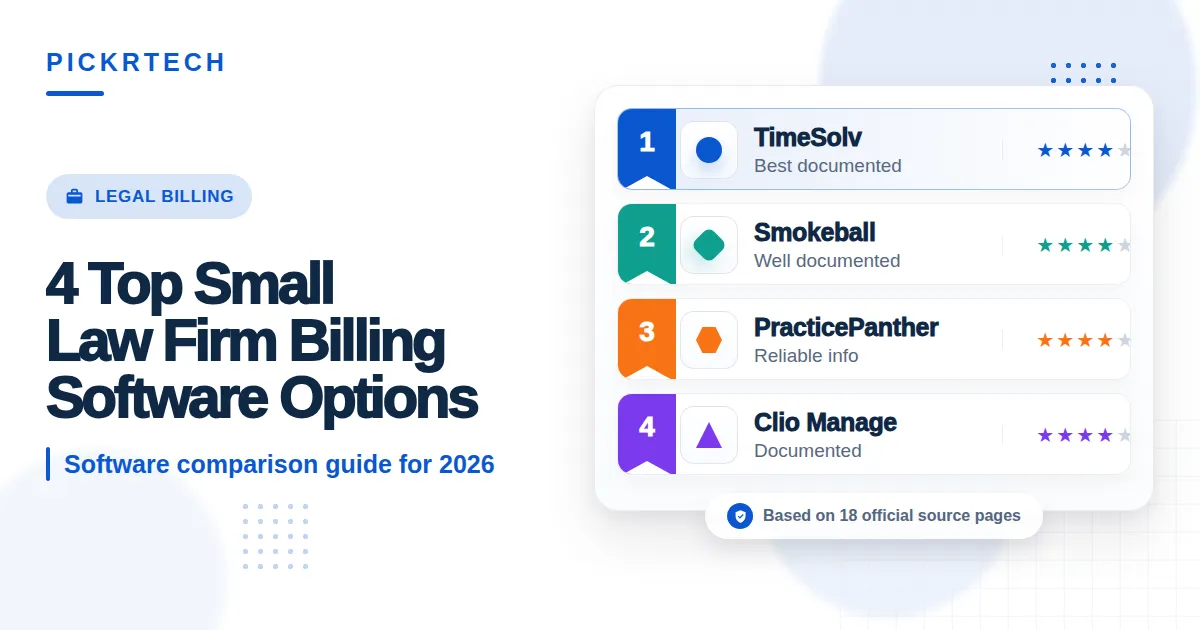
Small law firm billing software Automatic time tracking timeline
This article may contain affiliate links. We may earn a commission when you sign up through our links — at no extra cost to you. Our recommendations are based on independent evaluation and are not influenced by commissions.
TL;DR: Solo attorneys and small law firms managing tight cash flow and trust accounting compliance often find PracticePanther the best value for their specific needs—it combines integrated trust accounting and billing at $49/user/month without forcing expensive practice management purchases. That said, if your firm is hemorrhaging revenue from underbilled hours, Smokeball’s automatic time capture might justify the higher cost ($69–89/user/month), since it typically recovers 20–30% more billable hours than manual tracking. [1]
How we evaluated these tools
We analyzed these four billing platforms with solo attorneys and small firm managers (1–10 users) in mind. You’re facing real operational constraints: tight budgets that demand transparent per-user pricing, ethical compliance requirements around IOLTA trust accounting, and limited time for complex setup. The evaluation draws on official product documentation, public pricing pages, vendor feature specifications, and structured comparison of how each platform handles the workflows that actually make or break small legal practices.
Our evaluation focused on six core decision axes:
- Automatic time capture for retrospective billing from email and document activity — Solo attorneys often forget to start timers; platforms that retroactively capture billable work from email activity can recover 20–30% of missed billable hours without requiring attorney discipline.
- IOLTA trust accounting with three-way reconciliation built into billing workflow — State bar ethics rules require trust accounting compliance; choosing a platform that integrates IOLTA tracking into billing avoids maintaining separate accounting software and the reconciliation errors that separate systems invite. [2]
- LEDES invoice formatting and e-billing submission for corporate clients — Firms regularly billing corporate counsel with strict e-billing requirements need platforms that generate LEDES98B and LEDES1998B formats and support XML submission without manual reformatting.
- Per-user pricing transparency and entry-level cost for 1–10 user firms — Tight budgets mean hidden per-user costs or plan tiers that hide essential features (like trust accounting in the entry-level tier) are dealbreakers; transparent pricing at $39–89/user/month is the realistic range for small firms.
- QuickBooks and Xero two-way sync for maintaining existing accounting workflows — Most small firms already use QuickBooks or Xero; billing software must export data bidirectionally to avoid manual reconciliation of invoices against accounting records.
- Implementation complexity and time to operational billing for small teams — Solo attorneys cannot afford 6–8 weeks of configuration; platforms requiring less than 2 weeks to first invoice are critical for cash flow continuity.
All information here is based on official product pages, public pricing documentation, vendor feature specifications, and verified claims cross-checked against multiple sources. Pricing and features change frequently—verify current rates and plan specifications at each vendor’s official pricing page before making a purchase decision. Last reviewed: 2026-05-12
What matters when choosing small law firm billing software
Selecting small law firm billing software requires balancing three competing tensions: the cost of underbilling through missed time entries versus the cost of overly complex billing systems, the need for regulatory compliance against implementation overhead, and the desire to consolidate tools against the reality that all-in-one platforms often do nothing exceptionally well.
Automatic time capture vs. manual timer discipline. Attorneys and paralegals frequently forget to start timers or fail to clock in retroactively, creating a consistent 15–30% revenue leakage across most small firms. Smokeball and some competing tools now capture billable time automatically from email activity, calendar entries, and document edits, eliminating the discipline problem entirely. However, automatic capture adds configuration complexity upfront and requires attorney comfort with AI-driven time suggestions. Manual timer platforms like Clio Manage and PracticePanther place the burden on the user but are faster to set up and easier to control. The real trade-off is implementation friction (2–4 weeks with automatic capture setup versus 3–5 days with manual timers) against long-term revenue recovery. For firms with chronic underbilling, the 2–4 week setup cost pays for itself within 90 days; for disciplined timekeepers, manual timers avoid unnecessary complexity.
Trust accounting as a built-in feature vs. external accounting software. IOLTA compliance is non-negotiable for any firm handling client funds. Most small firms still maintain separate trust accounting in QuickBooks or spreadsheets because legacy billing tools lacked integrated trust accounts. PracticePanther and Smokeball now include IOLTA reconciliation directly in the billing platform, eliminating the need for a separate accounting system and the monthly reconciliation horror of matching trust ledgers to billing entries. TimeSolv and Clio Manage on the entry-level tier lack trust accounting, forcing firms to maintain external accounting alongside billing. The cost trade-off is real: integrated trust accounting platforms cost slightly more per user ($49–89/month), while standalone billing tools cost less ($39–69/month) but require purchasing or maintaining separate accounting software (QuickBooks costs $14–25/month additional). For solo attorneys, the integrated option almost always wins financially and operationally.
LEDES compliance for corporate clients vs. simplicity for flat-fee or fixed-matter work. If your firm bills corporate counsel or handles insurance defense, LEDES invoicing is a hard requirement—TimeSolv excels here with customizable LEDES formatting and XML submission. If your practice is primarily individual clients on flat fees or fixed retainers, LEDES support is unused overhead. Most platforms support basic LEDES formatting (PracticePanther, Clio Manage), but only TimeSolv and Smokeball provide the deep LEDES customization that corporate billing requires. Evaluate this based on your actual revenue mix: if corporate clients represent less than 10% of billing, don’t pay premium pricing for TimeSolv’s LEDES depth. [3]
Entry-level pricing and feature gates. Watch for hidden feature gates in entry-level plans. Clio Manage’s $39/month EasyStart plan excludes trust accounting entirely, forcing an upgrade to the $69/month Essentials tier if you need IOLTA compliance. PracticePanther includes trust accounting at $49/month, making it genuinely cheaper for small firms with that requirement. TimeSolv at $39/month is the lowest price but excludes trust accounting entirely. Smokeball starts at $69–89/month and includes trust accounting, making it expensive for budget-constrained solos but reasonable for 3–5 attorney firms that can share the cost.
When evaluating small law firm billing software, start with your regulatory and revenue requirements (Do you need integrated trust accounting? Do you bill corporate clients with LEDES requirements?), then layer on your operational reality (Can your team tolerate 2–4 weeks of setup for automatic time capture, or do you need something operational within a week?). The right tool depends less on feature lists than on which combination of constraints—compliance, cash flow, integration depth, and time-to-value—dominates your firm’s decision.

Small law firm billing software comparison — Smokeball, Clio Manage
Comparison table
The table below compares entry-level pricing, core strengths, and primary caveats for each platform.
| Product | Entry-level pricing | Core strength | Main caveat |
|---|---|---|---|
| Smokeball | $69–89/user/month | Automatic time capture + integrated trust accounting | Requires 2–4 weeks setup; full practice management suite bundled |
| Clio Manage | $39–69/user/month | 250+ integrations; LEDES formatting; client payment portal | Entry-level tier ($39) lacks trust accounting entirely |
| TimeSolv | $39/user/month | Deep LEDES customization; offline time tracking; QuickBooks sync | No built-in trust accounting; dated interface; lacks practice management |
| PracticePanther | $49/user/month | Trust accounting in base plan; intuitive invoice builder; Stripe integration | Fewer than 50 integrations; limited custom reporting; manual time tracking only |
Product reviews
Smokeball

Automatic time tracking timeline showing chronological activity
Smokeball’s reputation rests on one core capability: automatic time capture. The platform monitors email, documents, and phone calls, then suggests billable entries without requiring an attorney to start a timer. This solves the most painful problem small firms face—revenue leakage from missed or forgotten time entries. For small teams (3–10 users) that chronically underbill, Smokeball delivers a direct path to revenue recovery without adding administrative staff to chase time entries.
Smokeball’s strengths center on operational time recovery and compliance integration. The AutoTime feature captures billable activity across email, documents, and calendar entries.
According to vendor-reported data, this reduces missed billable hours by an estimated 20–30% compared to manual timer entry. The platform includes built-in IOLTA trust accounting with three-way reconciliation, meaning you can track client funds and billing within a single system without maintaining separate QuickBooks trust accounts. The narrative billing feature automatically generates detailed invoice descriptions from captured document activity, reducing client disputes about what work was performed and why charges incurred.
Smokeball’s pricing creates barriers for budget-conscious solos. Entry-level cost starts at $69–89 per user per month, which approaches enterprise-level costs and can exceed tight firm budgets.
The comprehensive practice management suite adds significant configuration overhead—expect 2–4 weeks of setup time before billing workflows are fully operational, creating a cash flow gap if you need immediate billing functionality. Deeper features like automated document assembly and template customization require the premium plan tier and substantial upfront investment in template creation before they deliver measurable value.
Best for: Small firms (3–10 users) losing revenue from inconsistent time tracking and needing automatic capture across email and document activity.
Not ideal for: Solo attorneys on limited budgets seeking simple, low-cost billing without purchasing a full practice management suite.
Unlike TimeSolv, Smokeball requires purchasing the full practice management suite even if you primarily need automated billing functionality, increasing total cost of ownership but delivering more integrated workflows across case management, billing, and time tracking.
Smokeball’s comprehensive practice management suite adds significant configuration overhead—verify onboarding timelines and current implementation expectations at https://www.smokeball.com/features before committing.
Clio Manage
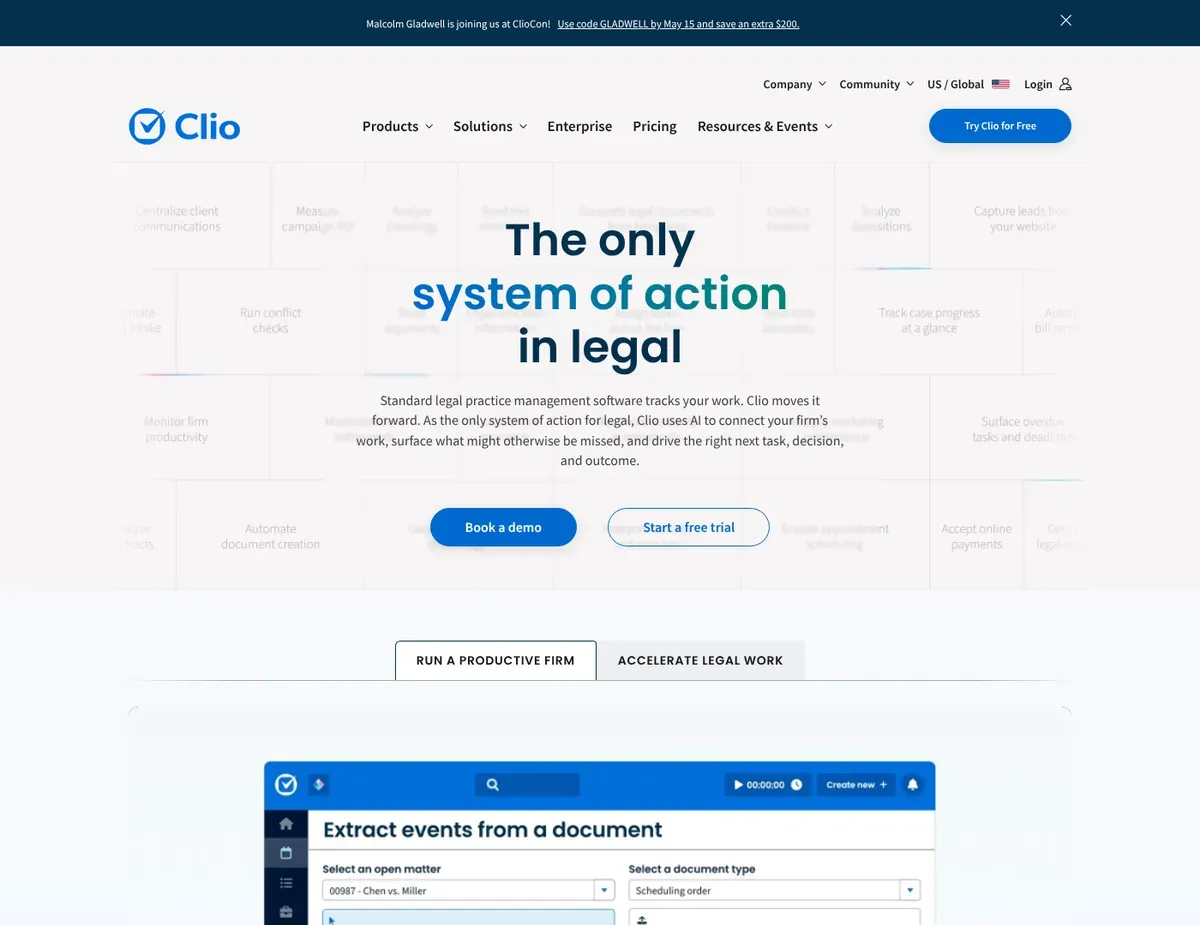
Dashboard displaying matter overview with financial metrics
For tech-forward small firms already using cloud tools like Dropbox, Office 365, or Google Workspace, Clio Manage works as a billing hub that reaches into the tools you already use daily. The platform connects with over 250 legal and business applications, providing ecosystem connectivity that positions it as the integration-first choice. It targets small firms (1–10 users) with established tech stacks who need billing that connects seamlessly rather than billing that replaces everything.
Clio Manage’s greatest strengths lie in integration depth and corporate e-billing support. The platform connects with over 250 legal and business applications—QuickBooks, Xero, Dropbox, Office 365, major e-filing systems, and niche practice management tools—making it unusually flexible for firms with existing software investments. Industry-standard LEDES98B and LEDES1998B invoice formatting with one-click generation handles corporate client e-billing requirements without manual reformatting.
Clio Payments enables your clients to pay retainers and invoices directly via credit card or ACH through secure client portal links, reducing accounts receivable cycles and the administrative burden of manual payment tracking.
Clio Manage’s trust accounting and time tracking features present trade-offs worth understanding. The entry-level EasyStart plan ($39/user/month) lacks trust accounting capabilities entirely, requiring an upgrade to the $69/user/month Essentials plan for firms handling IOLTA accounts—a significant mid-contract surprise for practices assuming entry-level billing includes compliance features. Time tracking requires manual timer operation or post-hoc manual entry; unlike Smokeball, Clio does not automatically capture billable activity from email or document interactions, placing the discipline burden on your attorneys. Payment processing rates via Clio Payments (2.95% credit card) run approximately 0.5% higher than competitive legal-specific processors like LawPay when processing high retainer volumes.
Best for: Tech-forward small firms already using multiple cloud tools and needing billing that integrates into your established ecosystem.
Not ideal for: Firms needing robust automatic time capture to address chronic underbilling, or practices without existing integration requirements who would benefit from simplicity.
Unlike Smokeball, Clio requires manual time tracking initiation but compensates with substantially deeper third-party integrations and ecosystem connectivity that firms with established tech stacks rely on.
Clio Manage’s trust accounting features are plan-tier dependent—verify that your intended plan tier includes IOLTA reconciliation before purchase at https://www.clio.com/pricing.
TimeSolv
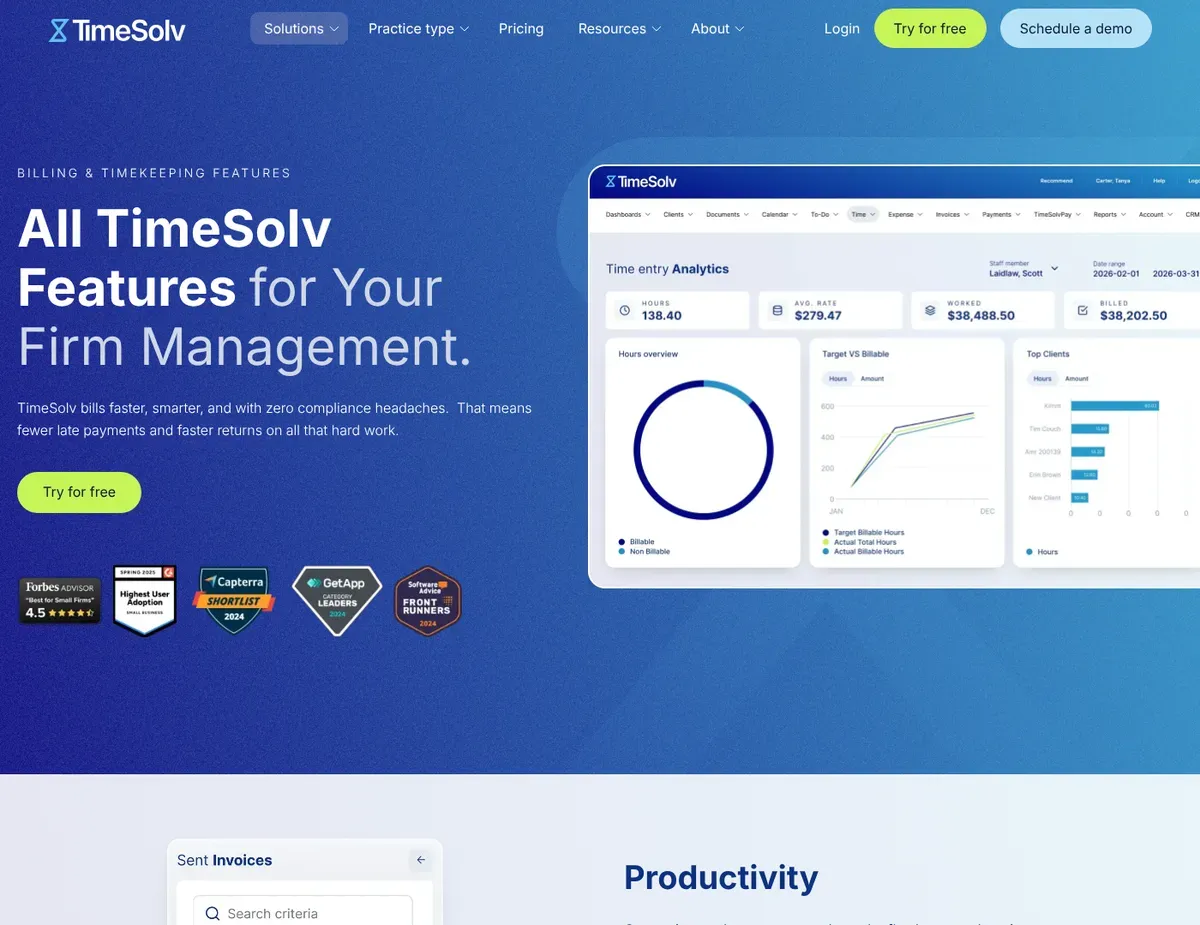
Time entry grid interface with multiple timer management and detailed
TimeSolv occupies a specific niche: firms that already have accounting software and practice management tools but need best-in-class standalone billing with deep LEDES compliance. The platform is built for attorneys working offline, in courthouses, and in settings with poor internet connectivity. It targets practices handling corporate defense or insurance work that requires sophisticated LEDES formatting without forcing adoption of an all-in-one practice management system.
TimeSolv’s core strengths address billing depth and operational resilience in offline settings. Deep LEDES billing support includes format customization and e-billing XML submission, handling complex corporate billing requirements more extensively than general practice management tools—firms with multiple corporate clients appreciate the ability to customize invoice format per client without manual reformatting. Two-way synchronization with QuickBooks Desktop and Online allows you to maintain your existing accounting workflows while upgrading to specialized legal billing capabilities.
Offline time tracking capability captures entries without internet connection and automatically syncs when connectivity resumes, solving a real problem for attorneys working in courthouses or during travel without reliable internet. [4] [5]
TimeSolv’s approach as a standalone tool creates meaningful limitations. Lacks built-in trust accounting features entirely, forcing firms with IOLTA compliance needs to maintain separate accounting software or manually track trust transactions outside the system—a significant operational burden for practices handling client funds. The interface appears dated compared to modern legal platforms, with multiple nested menus required to access basic reporting functions like collection rates or realization metrics. The mobile app offers limited functionality compared to desktop; you cannot generate or email invoices from mobile devices, requiring access to the desktop application for complete workflows.
Best for: Small firms that already have accounting software and practice management tools but need best-in-class standalone billing with LEDES compliance for corporate clients.
Not ideal for: Practices seeking an all-in-one solution to consolidate multiple subscriptions, or firms needing integrated trust accounting within their billing platform.
Unlike Clio Manage, TimeSolv focuses exclusively on billing and time tracking without attempting to provide practice management, making it more affordable but requiring separate tools for case management and client communication.
TimeSolv’s feature roadmap and interface updates may have evolved since this review—verify current capabilities and mobile functionality at https://www.timesolv.com/features before assuming its current limitations remain unchanged.
PracticePanther
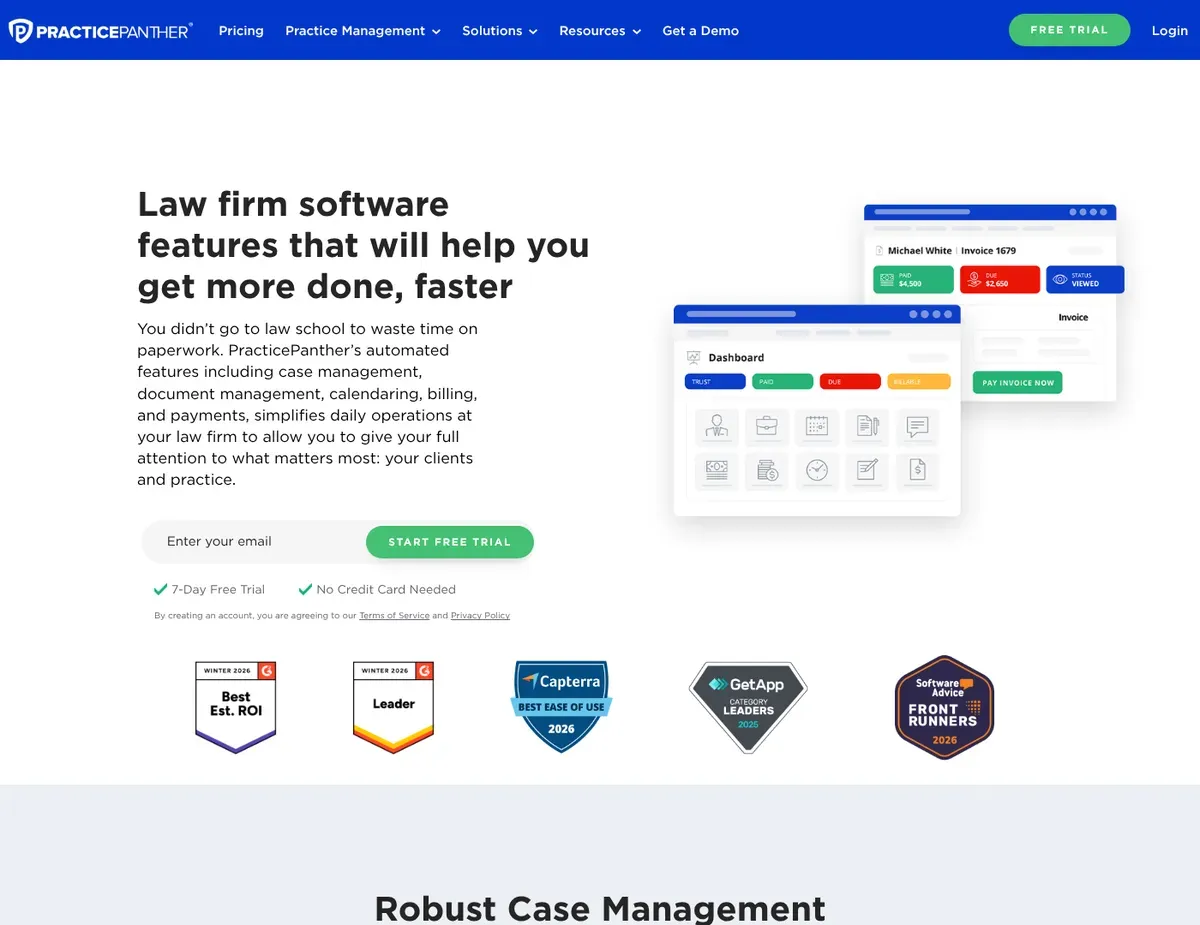
Contact and matter management interface with integrated billing
PracticePanther delivers strong value for budget-conscious solo attorneys and small firms who need integrated trust accounting and billing without paying for premium practice management features they won’t use. The platform starts at $49/user/month—the lowest entry-level price among these four options—with trust accounting, billing, and payment processing all included in the base tier. It’s designed for solos and small practices (1–5 users) who want to consolidate practice management, billing, and trust accounting in a single platform without breaking the budget.
PracticePanther’s strengths emphasize value, ease of use, and payment integration. Competitive pricing starting at $49/user/month with trust accounting included in base plans offers strong value for solo attorneys and small firms managing client funds. The drag-and-drop invoice builder with legal-specific templates pre-configured for common practice areas (personal injury, family law, criminal defense) allows you to generate professional invoices without technical setup.
Built-in payment processing via Panther Payments and Stripe integration enables online retainer collection directly linked to trust accounts, reducing manual reconciliation steps and accelerating cash flow. [6] [7]
PracticePanther’s limitations reflect limited ecosystem integration and feature constraints on the entry-level tier. The integration marketplace offers fewer than 50 third-party connections, limiting connectivity for firms relying on specialized tools like specific e-filing systems or niche document management platforms. Automated billing triggers for recurring invoices are only available on the $69/user/month Business plan, requiring solos on the Starter tier to manually initiate invoice runs each billing cycle. Custom reporting capabilities are constrained; firms needing to build reports across specific matter types, timekeeper productivity, and billing realization rates must export data to external spreadsheet tools.
Best for: Budget-conscious solo attorneys and small firms who need integrated trust accounting and billing without paying for premium features, prioritizing ease of setup and daily use.
Not ideal for: Firms with complex tech stacks requiring extensive third-party integrations, or practices needing advanced custom reporting across multiple attorneys.
Unlike Clio Manage, PracticePanther includes trust accounting in its entry-level tier but sacrifices the depth of third-party integrations that connected firms with established tech ecosystems require.
PracticePanther’s tier structure and available integrations evolve regularly—verify current plan feature allocations and integration count at https://www.practicepanther.com/pricing before purchase.
Scenario recommendations
The following scenarios outline which tool best fits specific firm constraints and priorities.
Scenario 1 – Solo attorney on a tight budget requiring IOLTA compliance: PracticePanther makes sense if you’re managing client funds and need trust accounting compliance without premium practice management costs. The $49/user/month entry-level price includes trust accounting, billing, and payment processing—no tier upgrade required for IOLTA features. The caveat is that manual time tracking requires attorney discipline; if you’re chronically underbilling, the low price advantage erodes when you realize you’re still missing 15–20% of billable time. The practical starting point: run a 30-day manual time tracking test with PracticePanther before purchasing, logging every billable task manually to see if your discipline holds.
Scenario 2 – Small firm (3–10 users) losing revenue from inconsistent time tracking: Go with Smokeball when your firm’s primary pain is revenue leakage from forgotten time entries across email and documents. The $69–89/user/month cost is higher than PracticePanther or TimeSolv, but according to vendor case studies, automatic time capture typically recovers 20–30% more billable hours than manual tracking, paying for the premium pricing within 90 days for most small firms. The substantial caveat is that 2–4 weeks of setup time creates a cash flow gap; if your firm needs immediate billing functionality, Smokeball’s deployment timeline may be unacceptable. Budget the setup time and training cost before committing.
Scenario 3 – Tech-forward firm with established cloud stack needing centralized billing: Clio Manage fits when your team already uses Office 365, Dropbox, QuickBooks, and specialized e-filing tools, and you want billing that connects into that ecosystem without disrupting existing workflows. The 250+ integrations provide connectivity that standalone billing tools can’t match. However, verify that your intended plan tier ($39 EasyStart or $69 Essentials) includes trust accounting before purchase, as the entry-level tier excludes IOLTA features entirely—a critical feature gate that catches many smaller practices.
Scenario 4 – Firm with existing practice management and accounting software seeking best-in-class standalone billing: TimeSolv is the right call if you have QuickBooks or Xero running your accounting and separate practice management software for case tracking, and you need specialized LEDES billing for corporate clients without forcing adoption of yet another all-in-one platform. The offline time tracking and deep LEDES customization solve real problems for defense and insurance practices. The trade-off is that TimeSolv lacks trust accounting entirely, meaning you’ll continue using QuickBooks or manual tracking for client funds—acceptable only if your existing accounting system already handles IOLTA reconciliation smoothly.
Setup guide
Step 1: Run a 30-day pilot test with your actual billing data before migration. Export your last 30 days of time entries and matter information from your current billing system (or spreadsheet). Set up trial accounts in your two finalist platforms and manually import 5–10 representative matters. Time how long it takes to generate a sample invoice in each platform, and verify that trust accounting reconciliation matches your current records. This step prevents the costly surprise of discovering the new system doesn’t capture your firm’s billing patterns correctly after you’ve purchased and trained your team.
Step 2: Migrate historical trust balances and unbilled time entries carefully. Most platforms provide import templates for QuickBooks or prior billing system data. Before importing live data, test the import process with a subset of one month’s entries. Verify that trust account balances import correctly and that unbilled time entries land in the right matters and timekeepers. Document the mapping of your prior system’s cost centers, matter codes, and timekeepers to the new platform’s structure—this step prevents post-migration confusion when invoices reference the wrong matter or timekeeper.
Step 3: Configure trust accounting reconciliation and LEDES formatting specific to your firm’s practice areas. If you selected Smokeball, PracticePanther, or Clio Manage with trust accounting, work with the platform’s onboarding team to set up three-way reconciliation against your bank statements and retainer liability accounts. If you selected TimeSolv or Clio Manage with LEDES billing, customize invoice templates for your major client types (corporate counsel, insurance carriers, individual clients) so that the first invoice generated requires minimal manual reformatting. This configuration step takes 5–10 hours but prevents manual invoice corrections during the critical first 60 days.
Step 4: Set up payment processing and client portal access aligned with your trust accounting. For PracticePanther or Clio Manage, enable Stripe or Clio Payments so clients can submit retainers and invoice payments online, with payments automatically reconciling against trust accounts. Configure client portal access so clients can view matter status and invoices without seeing internal notes or time details. Test the payment flow with a test credit card to verify that payment processing feeds correctly into your reconciliation system.
Step 5: Train your team on time entry, billing, and reconciliation workflows specific to your new platform. For Smokeball, train attorneys on reviewing and approving AutoTime suggestions rather than starting timers manually—emphasize that reviewing takes 30 seconds per suggestion and catches any incorrect auto-captures. For manual timer platforms (Clio Manage, PracticePanther, TimeSolv), run a weekly time entry audit for the first 30 days to ensure all billable work is captured before invoicing. Schedule a monthly trust accounting reconciliation check-in with your accountant or office manager to verify that trust balances match the billing system, catching discrepancies before they compound.
FAQ
Q: Which option is best for solo attorneys on a limited budget?
Reach for PracticePanther at $49/user/month if you need trust accounting compliance and straightforward billing without practice management complexity. The entry-level price is the lowest among these four, and trust accounting is included in the base tier—no upgrade required for IOLTA features. The caveat is that PracticePanther requires manual time tracking, meaning you’ll need attorney discipline to avoid the 15–20% revenue leakage that automatic capture platforms prevent. If your practice has chronic underbilling problems, the lower price advantage diminishes; Smokeball at $69–89/month may be worth the premium if revenue recovery outweighs the cost difference.
Q: Do any of these tools offer genuinely free plans for small firms?
None of these four platforms offer free tiers with meaningful functionality. TimeSolv and Clio Manage provide free trials (14–30 days), allowing you to test features before purchasing, but there’s no permanent free option. If free billing software is a hard requirement, you’ll need to evaluate tools outside this comparison. For firms able to spend $39–49/user/month, TimeSolv ($39) and PracticePanther ($49) represent the entry-level ceiling; below that price point, billing tools typically exclude trust accounting or limit integrations.
Q: How do these options handle LEDES billing for corporate clients?
TimeSolv is the strongest choice for firms with significant corporate client billing, offering deep LEDES customization, format flexibility, and e-billing XML submission without manual reformatting. Smokeball and Clio Manage support basic LEDES98B formatting with one-click generation, suitable for occasional corporate invoices but not for firms billing 50%+ of revenue to corporate counsel. PracticePanther supports basic LEDES formatting but lacks the customization depth for complex corporate requirements. If LEDES billing represents less than 10% of your revenue, PracticePanther or Clio Manage suffice; if it exceeds 25%, TimeSolv’s specialized billing depth becomes worth the additional tool in your stack.
Q: Can I use these tools if I already have practice management software?
Absolutely. TimeSolv is explicitly designed for this scenario—it integrates with QuickBooks and operates as a standalone billing platform without forcing adoption of practice management features you already have. Clio Manage and PracticePanther also work as billing-focused layers on top of existing systems, though both include some practice management features. Smokeball is the least modular option; it bundles practice management with billing, so if you’re satisfied with your current practice management tool, Smokeball adds unnecessary overhead. For firms with existing practice management, TimeSolv or Clio Manage are the most appropriate choices.
Q: Which software is easiest to implement without dedicated IT support?
Stick with PracticePanther for fastest time-to-value if you need implementation within days rather than weeks. The setup requires minimal configuration beyond invoice template customization and payment processing setup—most solo attorneys are operational within 3–5 days. Clio Manage is similarly quick if you’re selecting the platform primarily for billing rather than attempting to migrate case management and client communication simultaneously. Smokeball requires 2–4 weeks of setup even with vendor support, making it unsuitable for firms needing immediate billing functionality. TimeSolv requires QuickBooks integration configuration, adding 1–2 weeks to setup. For fastest implementation without IT support, PracticePanther is the practical choice.
Final verdict
No single platform wins across all small law firm scenarios because the right choice depends entirely on your firm’s operational constraints.
For solo attorneys prioritizing cost and trust accounting compliance: PracticePanther is the recommendation at $49/user/month with trust accounting included in the base tier. The entry-level price is the lowest among these four options, and you avoid the 2–4 week setup burden that Smokeball requires. Trade-off: manual time tracking requires attorney discipline, and integration options are limited compared to Clio Manage.
For small firms (3–10 users) losing revenue from inconsistent time tracking: Smokeball stands out thanks to automatic time capture that, according to vendor-reported data, recovers 20–30% of missed billable hours through email and document monitoring. The $69–89/user/month cost premium is offset by revenue recovery within 90 days for most small firms. The caveat is the 2–4 week implementation timeline and the requirement to purchase the full practice management suite even if you primarily need billing.
For tech-forward firms with established cloud stacks: Clio Manage’s 250+ integrations position it as the billing hub that reaches into tools you already use—Office 365, QuickBooks, Xero, e-filing systems. The $69/month Essentials tier with trust accounting offers broad ecosystem connectivity that standalone billing tools can’t match. Verify plan-tier feature availability before purchase, as the $39 entry-level tier excludes trust accounting entirely.
For firms with existing accounting and practice management seeking standalone LEDES billing: TimeSolv delivers the deepest LEDES customization and offline time tracking resilience without forcing adoption of another all-in-one platform. Start at $39/user/month but accept that trust accounting remains external—TimeSolv is the tool for firms that already have QuickBooks and case management, not a replacement for them.
Before purchasing any of these platforms, run a 30-day pilot test using your actual billing data from the past month. Migrate 5–10 representative matters and verify that the platform captures your firm’s specific billing patterns, trust reconciliation works correctly, and invoice generation requires minimal manual correction. This pilot investment prevents the costly surprise of discovering the new system doesn’t fit your workflows after you’ve trained your team and committed to a contract.
Sources
- ↑ Smokeball — Productivity Features — https://www.smokeball.com/features/productivity
- ↑ Smokeball — Trust Accounting Feature — https://www.smokeball.com/features/trust-accounting
- ↑ TimeSolv — LEDES Billing Feature — https://www.timesolv.com/features/ledes-billing
- ↑ TimeSolv — Features Page — https://www.timesolv.com/features
- ↑ TimeSolv — QuickBooks Integration Page — https://www.timesolv.com/quickbooks
- ↑ PracticePanther — Pricing Page — https://www.practicepanther.com/pricing
- ↑ PracticePanther — Billing Features — https://www.practicepanther.com/features/billing
