Best HR Platforms for Small Businesses Compared in 2026

HR platforms Employee record and people-ops workspace with profile cards
This article may contain affiliate links. We may earn a commission when you sign up through our links — at no extra cost to you. Our recommendations are based on independent evaluation and are not influenced by commissions.
TL;DR: Among today’s HR platforms, BambooHR is the best all-around pick for most small businesses because it balances core employee records, onboarding, document management, PTO, and day-to-day people operations better than a payroll-first tool or a broader automation suite. Gusto is the smarter choice if payroll is your first priority, Rippling wins when HR and IT automation must live together, and HiBob fits growing teams that want more structure around people programs.
What matters when choosing HR platforms
Start with the real job you need the system to do in the next 12 to 18 months, not the flashiest demo. For most SMB HR managers and operations leads, the immediate problem is not advanced AI or enterprise workforce planning. It is replacing spreadsheets, scattered offer letters, manual onboarding checklists, disconnected PTO tracking, and too many approval handoffs with one reliable system the team can actually roll out.
The first criterion is core HR system-of-record depth. If your team is still managing employee records in spreadsheets or shared folders, BambooHR stands out because it is built around giving teams a single source of truth for employee information — and that matters more than a broad feature list. A small team usually needs clean employee profiles, document storage, onboarding tasks, PTO records, and manager self-service before it needs sophisticated extras. Gusto can cover basic HR needs, but if your main pain is weak HR structure rather than payroll friction, a more HR-centric platform is usually the safer pick. [1]
The second criterion is your payroll path. Gusto is strongest for U.S. buyers who want payroll, benefits, hiring, and management tools in one accessible stack. It publishes entry pricing publicly, which gives you a real number to work with during shortlisting rather than requiring a sales call just to ballpark cost. BambooHR can also handle payroll for U.S. employees connected to records, time off, and benefits deductions, but the buying motion is less transparent up front. HiBob and Rippling may still fit your needs, yet payroll questions often require more validation around modules, integrations, or regional support before you can estimate real rollout effort. [2]
The third criterion is implementation effort for a lean team. Rippling is powerful — it can connect HR, IT, and spend in one place and automate onboarding and offboarding across employee systems. But that breadth creates unnecessary scoping work if your company only needs records, PTO, and onboarding for a 20-person team. Small businesses often overbuy automation too early, then spend weeks debating modules and handoffs when they really needed a stable HRIS first. [3]
The fourth criterion is maturity fit. HiBob leans into configurable workflows, analytics, surveys, and performance support alongside foundational HR — making it more attractive for a 35- to 50-person company formalizing people operations than for a 10-person founder-led team that mainly wants a simple employee database and faster payroll admin. Across this comparison, the safest buying process is to shortlist based on your first-phase workflows, check pricing transparency early, and ask every vendor to show what is native, what is add-on, and what still depends on integrations.
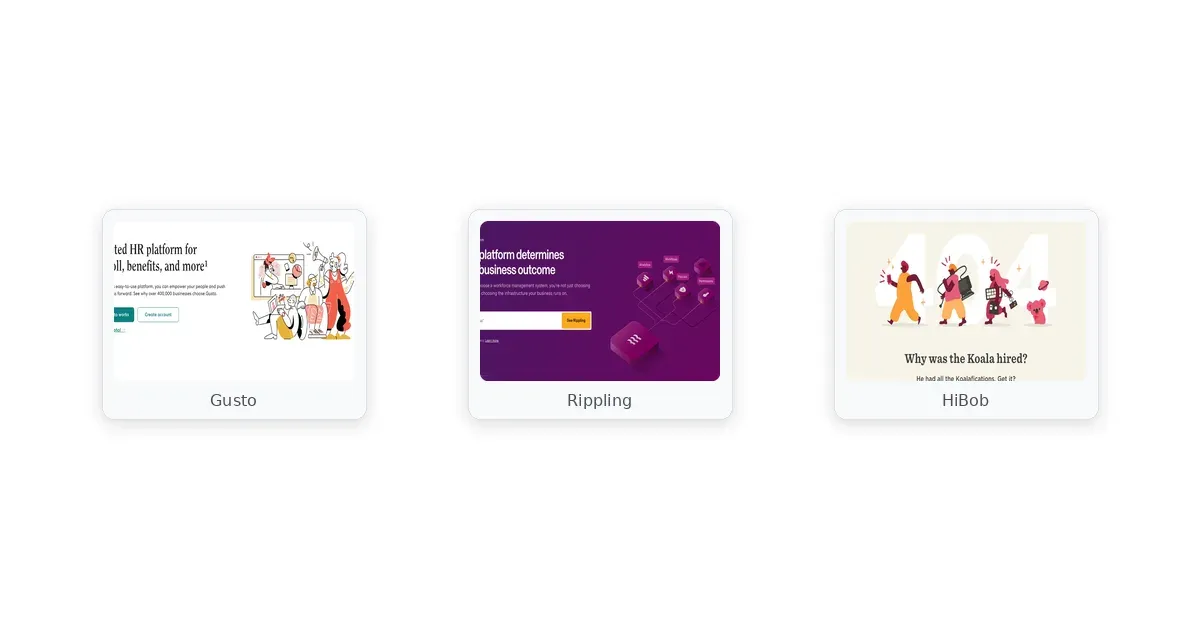
HR platforms comparison — BambooHR, Gusto, Rippling
Comparison table
The table below compares each product across pricing, differentiator, setup, and constraint.
| Product | Pricing | Differentiator | Setup | Constraint |
|---|---|---|---|---|
| BambooHR | Quote-based · no list pricing | HRIS-first SMB core HR | Moderate · HR-led rollout | Payroll scope needs validation |
| Gusto | Public pricing · $49+$6/person | Payroll-first SMB simplicity | Fast · payroll-led start | Lighter HRIS depth |
| Rippling | Quote-based · module-driven | HR + IT automation | Broad scoping · phased rollout | Easy to overbuy |
| HiBob | Quote-based · sales-led | Configurable people ops | Moderate-high · process design | Weaker payroll-first fit |
The table below compares each product across contract model, hidden add-ons, integration need, and simple first rollout.
| Validation point | BambooHR | Gusto | Rippling | HiBob |
|---|---|---|---|---|
| Contract model | Sales-led quote | Public starter pricing | Sales-led modules | Sales-led packaging |
| Hidden add-ons | Payroll, benefits, integrations | Higher tiers, add-ons | Module dependency risk | Payroll or partner dependency |
| Integration need | Moderate for broader stack | Moderate outside payroll core | Lower if all-in on platform | Moderate for payroll-heavy teams |
| Simple first rollout | Yes for HR-first teams | Yes for U.S. payroll-first teams | Possible with discipline | Better for growing teams |
The biggest pricing trade-off is straightforward: Gusto is easiest to budget during shortlisting because it gives small businesses public price visibility, while BambooHR, Rippling, and HiBob all require a sales conversation before you understand total cost and packaging. That does not automatically make Gusto the best value. It just means payroll-led tools are easier to estimate early, while broader HR or operations platforms may fit better long term but force more upfront work around modules, implementation scope, and contract details.
Product reviews
BambooHR
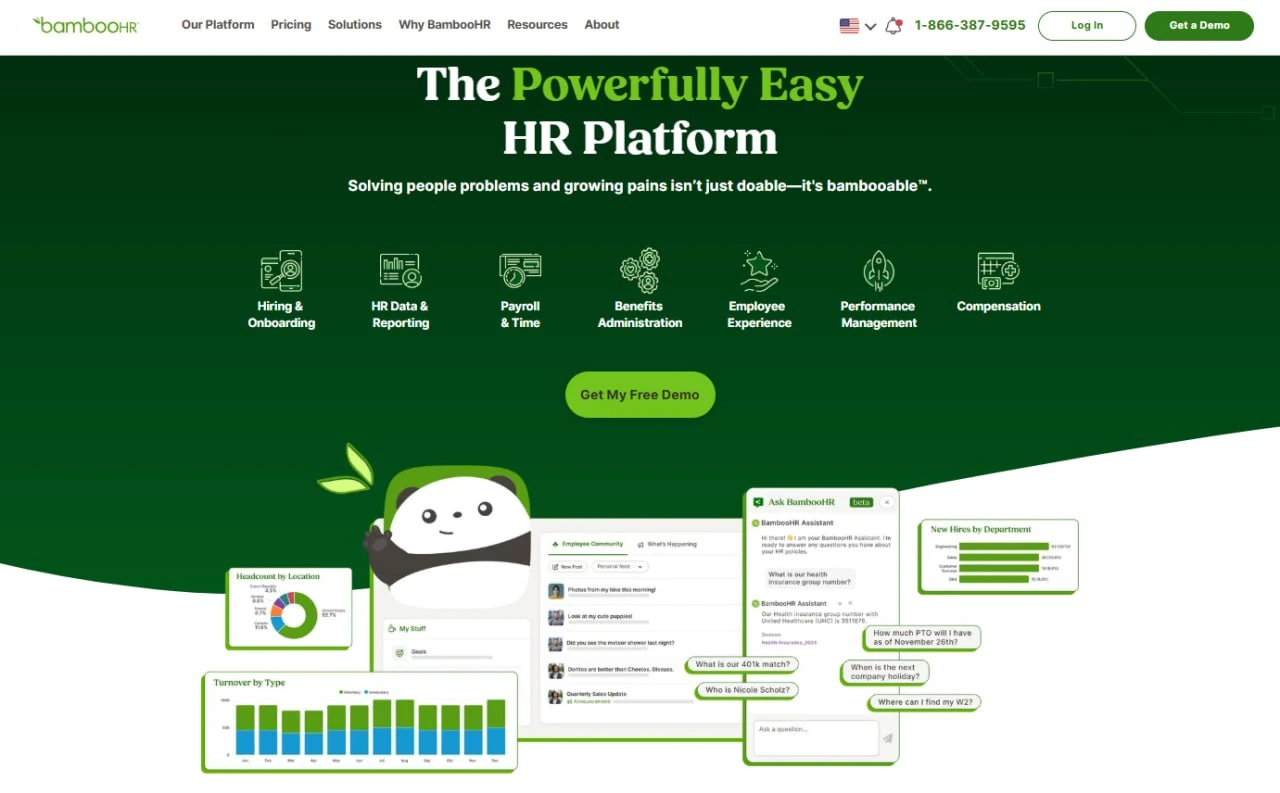
BambooHR homepage showing HR platform modules and dashboard preview
BambooHR is the best fit for small businesses that want a dedicated HR platform centered on employee records, onboarding, PTO, and day-to-day people operations. For a 15- to 40-person company replacing spreadsheets, shared drives, and ad hoc approval chains, it is the most balanced option in this shortlist because it behaves like an HRIS first rather than a payroll add-on or an operations control plane.
Its main strength is focus. BambooHR is built to give teams a single source of truth for employee information — which is exactly what many small HR teams are missing when employee data lives across email threads, folders, and payroll software. Public product pages clearly cover onboarding, time off, payroll, performance, and integrations, making it easier to verify what the platform actually does before you talk to sales. The platform also handles employee time-off requests and manager approvals in one place, which matters if your immediate goal is reducing repetitive admin rather than redesigning every workflow in the business.
Another advantage is its useful middle position. More HR-centric than Gusto, which helps when employee records, documents, onboarding tasks, and manager self-service are the main problem. Less operationally sprawling than Rippling, which is helpful for lean teams that do not want to evaluate app provisioning, identity workflows, and broader automation during the first phase of rollout. Compared with HiBob, BambooHR tends to feel more traditional and straightforward for smaller companies that need dependable core HR administration before they need deeper engagement or people-program structure.
The limitations are real. BambooHR does not publish standard list pricing on its main buying flow, so you cannot estimate cost cleanly during shortlisting without entering a quote process. It can also create extra evaluation work if your company wants payroll, benefits, and HR wrapped into one obvious package from day one, because you may need to confirm payroll availability, bundled scope, or third-party dependency rather than assuming every function is included in a standard SMB package. Very small U.S. teams that mainly want the quickest path to payroll may find Gusto easier to buy. Companies that specifically want HR plus IT automation from one platform will usually find Rippling more aligned.
Unlike Gusto, BambooHR is built around core HR workflows first — so it is a better fit when your biggest gap is HR structure rather than payroll convenience.
⚠ Caution: BambooHR promotes setup help and implementation resources, but the public site does not clearly confirm a typical rollout timeline or admin effort for a 15 to 40 person team as of this research — verify: Bamboohr — services.
Gusto
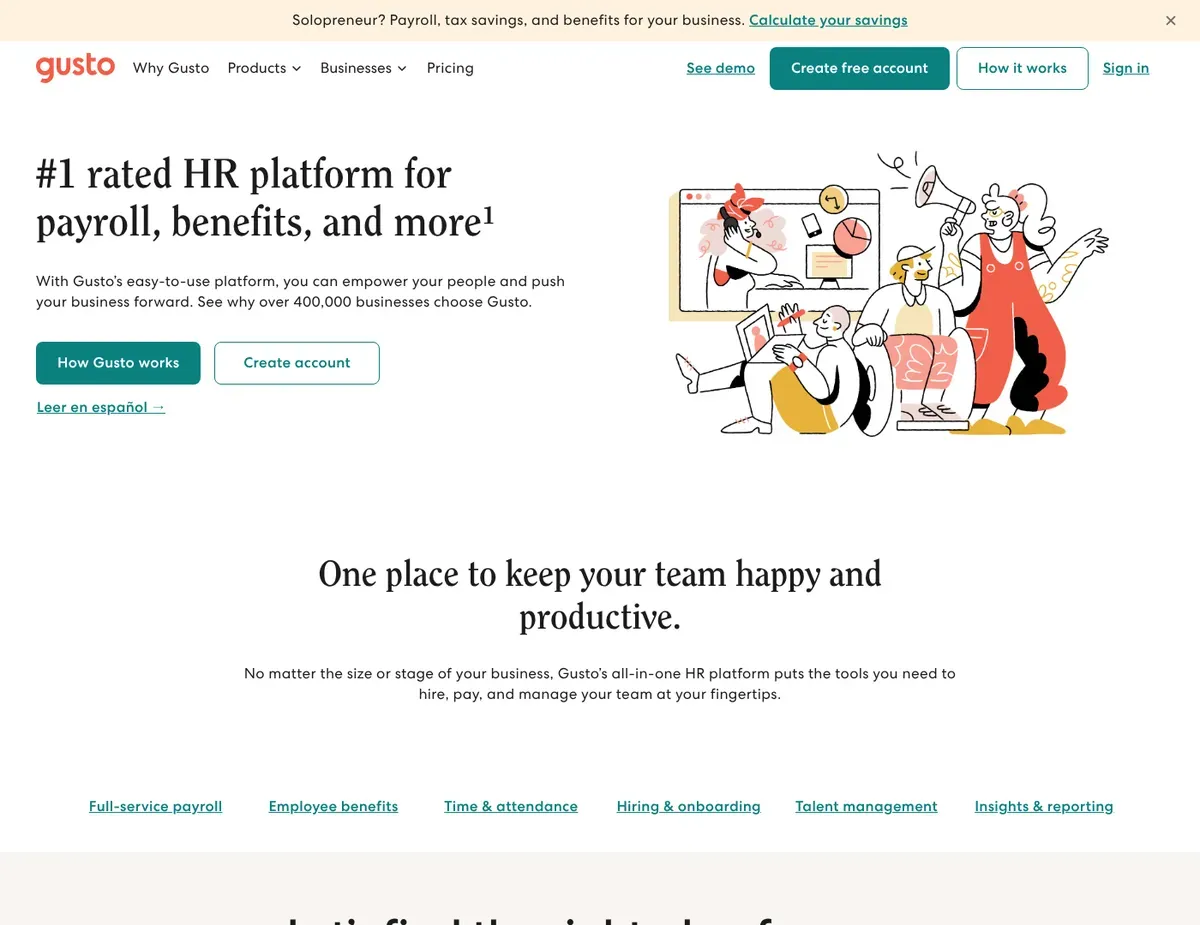
Gusto Payroll- and people-operations-oriented interface with employee onboarding
Gusto is the strongest option for U.S. small businesses that want payroll, benefits, onboarding, and basic HR in one accessible system. If you are an operations lead at a 10- to 25-person company and payroll accuracy, tax filings, contractor payments, and benefits admin are the issues causing the most pain, Gusto is often the fastest shortlist decision because its buying motion is clear and its product scope is easy to understand.
The strongest advantage is pricing and product clarity. Gusto states that its platform combines payroll, benefits, hiring, and management tools for small businesses, and its public site gives buyers a much clearer pre-demo picture than most competitors in this category. The platform claims customers can run payroll quickly and handle federal, state, and local payroll tax filings, which makes the value proposition concrete for an SMB that wants to reduce payroll admin rather than piece together separate systems. Gusto also includes employee self-service, onboarding tools, and time-off management in the same platform — meaning a very small team can cover a lot of practical ground without building a more complicated software stack right away.
Gusto’s public pricing is another meaningful strength. According to its pricing page, the Simple plan starts at $49 per month plus $6 per person per month — a level of transparency that is uncommon in this category and genuinely useful when you are comparing options under real budget pressure. That visibility speeds up shortlisting because you can estimate cost before investing time in calls. For founder-led or ops-led teams that need to act quickly, that matters almost as much as feature depth.
The trade-off is that Gusto is still a payroll-first choice. Teams wanting deeper HRIS structure, more configurable people workflows, or a stronger long-term system of record may hit its ceiling sooner than they would with BambooHR or HiBob. It is also a weaker fit if your evaluation has shifted toward international complexity or cross-functional automation with IT and app provisioning. In those cases, the same simplicity that makes Gusto appealing early can become a constraint later. Gusto is ideal when payroll-led implementation speed is the priority — not when you are trying to build a more mature people-operations architecture from the start.
Unlike BambooHR, Gusto leads with payroll and benefits administration, so it is usually easier for U.S. small businesses to price and implement early.
⚠ Caution: Gusto publicly confirms HR basics, onboarding, and people management tools, but the public product pages reviewed do not fully establish how far it goes as a dedicated HR system of record compared with more HRIS-centric products for records, documents, and broader people workflows — verify: Gusto — hr.
Rippling
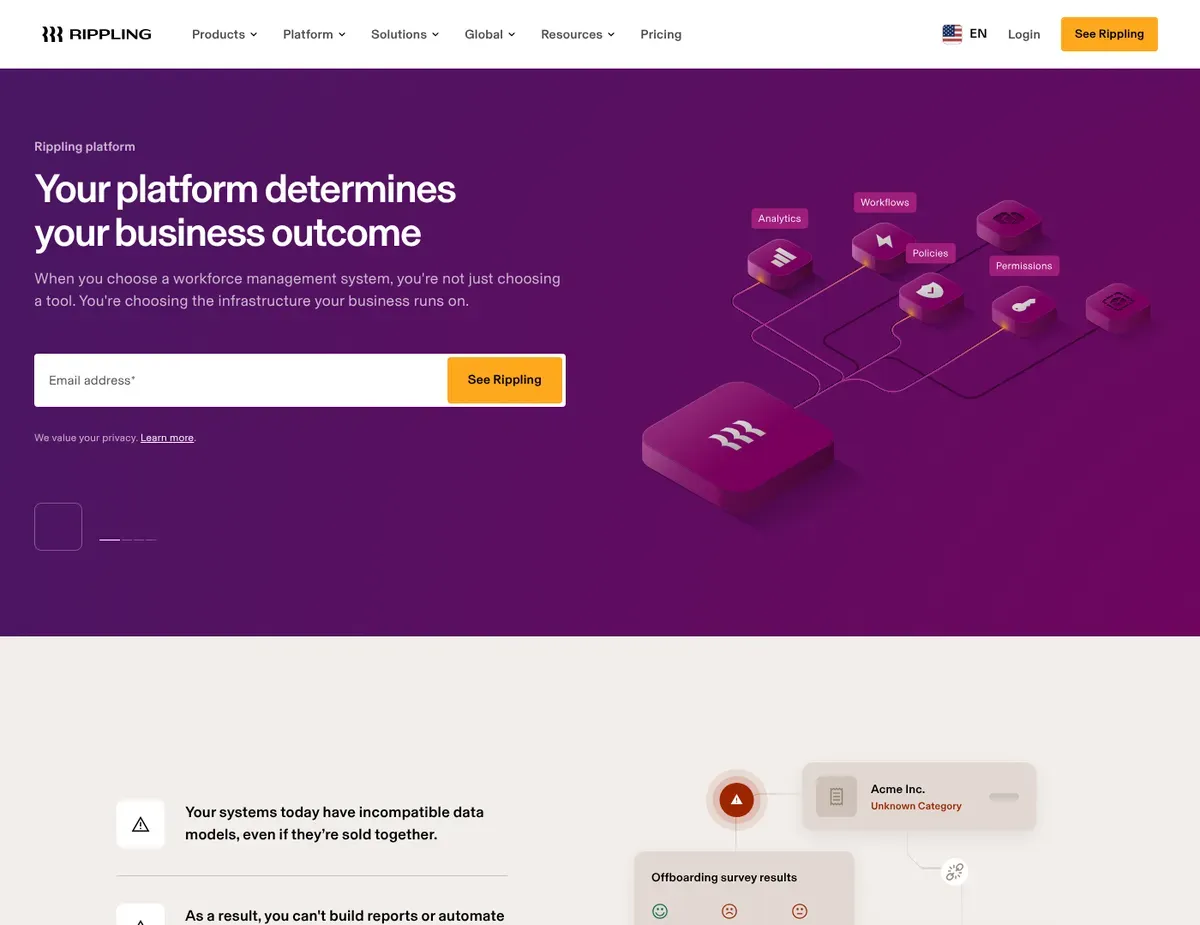
Rippling Unified admin console showing employee lifecycle workflows connected to payroll
Rippling is the top choice for SMBs that want HR plus payroll plus IT and app provisioning in one system. For an operations-heavy company with many SaaS tools, recurring onboarding and offboarding mistakes, or too many manual handoffs between HR, finance, and IT, Rippling stands apart because it is not just trying to be an HR system. It is trying to become the workflow hub for the entire employee lifecycle.
Its biggest strength is platform breadth with real automation relevance. Rippling positions itself around connecting HR, IT, and spend in one place — a meaningful differentiator for small businesses where one admin or ops generalist often owns tasks that cut across departments. The platform also claims the ability to automate onboarding and offboarding workflows across employee systems, which is more valuable than it sounds if new hires need multiple app accounts, permissions, payroll enrollment, and device setup coordinated without email chasing. Rippling further says it can handle app and device provisioning based on employee data changes, which makes it the clearest choice in this roundup for companies that want to reduce joiner-mover-leaver friction across business systems. [4]
That operational scope can save a lot of time when it matches your needs. A growing team with distributed employees, many SaaS subscriptions, and recurring termination or access-control risk may get more value from Rippling than from a narrower HRIS, because the platform can connect steps that would otherwise stay scattered across HR and IT. It also has strong public information across modules, payroll, identity, and workflow automation, which helps evaluators understand the broader story.
The downside is complexity. For a small team that only needs employee records, PTO, onboarding, and occasional payroll runs, Rippling can be more system than you need. You may find yourself evaluating modules, rollout phases, and governance questions that a simpler HR-first purchase would skip entirely. Its strongest differentiator is cross-functional automation — so if your team does not actually have app-provisioning or device-management pain, you risk spending budget and implementation attention on capabilities you will not use in the first year. Rippling is excellent for the right operating model. It is less attractive for a straightforward 15-person business simply trying to replace spreadsheets.
Unlike HiBob, Rippling’s strongest story is automation across HR, payroll, apps, and devices rather than a more HR-centric people-program experience.
⚠ Caution: Rippling’s platform breadth is a strength, but the public site does not clearly quantify implementation effort for a lean 15 to 40 person company that only needs HR basics at first — verify: Rippling — platform.
HiBob
HiBob People platform interface centered on employee profiles
HiBob is the best fit for growing SMBs that want a more modern people platform with stronger employee experience, workflow configurability, and structure for maturing HR programs. If your company is moving beyond basic HR administration and starting to care about surveys, analytics, performance support, and more formal manager workflows, HiBob deserves a close look — it is designed for a broader people-operations conversation than a payroll-first tool.
One major strength is that HiBob clearly positions Bob as an HRIS that helps companies streamline core HR tasks and automate common processes. That matters because it is not only a culture or engagement layer — it still addresses foundational HR needs. The platform supports automated workflows for onboarding, time off, and approvals, which makes it relevant for teams that want better operational consistency without moving all the way into enterprise HR software. Public materials also cover surveys, performance, compensation, analytics, and configurable workflows in enough depth to show why the product appeals to organizations formalizing people programs. [5]
HiBob’s practical advantage is maturity fit. Compared with BambooHR, it leans further into configurable people operations and employee experience. Compared with Gusto, it is less tied to the payroll-led SMB buying motion — which can be a good thing if your company’s priority is building a stronger manager and employee experience over time. It is also more HR-focused than Rippling, which helps if you want a people platform without turning the purchase into an IT automation project.
The limitations are mostly about buying friction and payroll fit. HiBob does not publish public list pricing, which means you will need a sales conversation before you can validate total cost and packaging during shortlisting — that adds friction if your evaluation timeline is tight. It is also a weaker fit for very small teams that mainly want simple U.S. payroll, basic onboarding, and a fast start. In those cases, Gusto is usually easier to justify and faster to implement. If your company specifically needs HR plus app and device automation, Rippling remains the better functional match. HiBob is strongest when a growing team is ready to invest in more structured people operations, not when the only goal is getting payroll and PTO under control as cheaply as possible.
Unlike Gusto, HiBob is designed more for configurable people operations and employee experience than for a straightforward payroll-first SMB purchase.
⚠ Caution: HiBob does not publish public list pricing for straightforward SMB shortlisting, so buyers need a sales conversation to validate total cost and packaging — verify: Hibob — pricing.
Scenario recommendations
Scenario 1 – Replacing spreadsheets and manual onboarding for a 15- to 30-person team: Pick BambooHR. It is the safest recommendation for a small business that needs a true HR system of record for employee profiles, documents, onboarding tasks, PTO, and manager approvals without taking on the broader rollout complexity of Rippling. BambooHR is especially strong when the current pain is scattered records and admin-heavy workflows rather than payroll alone. The caveat is that you should validate pricing and payroll scope early, because BambooHR is not as transparent as Gusto during shortlisting.
Scenario 2 – U.S. payroll-first team that wants fast implementation and budget clarity: Pick Gusto. Gusto makes the most sense when a founder-led or operations-led business primarily wants payroll, benefits, contractor payments, onboarding, and time-off management in one easy-to-price platform. The public pricing model helps a 10- to 25-person team estimate cost before entering a sales cycle, which is a real advantage when bandwidth is limited. The caveat is that if your HR needs are becoming more process-heavy or you want richer HRIS depth, Gusto may feel lighter than BambooHR or HiBob over time.
Scenario 3 – Operations-heavy company with many SaaS apps and offboarding risk: Pick Rippling. Rippling is the strongest option when HR handoffs affect app access, devices, payroll, and workflow automation, because it can connect employee lifecycle changes across systems in a way the other tools here do not. A 25- to 40-person company with recurring provisioning mistakes or audit concerns will get more practical value from Rippling’s breadth than from a narrower HR-only platform. The caveat is that very small teams can overbuy here, so scope the first phase tightly around the workflows you actually need.
Scenario 4 – Growing people team formalizing surveys, performance, and manager processes: Pick HiBob. HiBob is the best fit when a 35- to 50-person business is moving beyond basic admin and wants a more structured people-operations platform with configurable workflows, analytics, and employee experience tools. It gives growing companies room to build more mature HR programs without jumping directly to heavyweight enterprise software. The caveat is that payroll-first SMBs may find the buying process less simple than Gusto, and very small teams may not need this level of people-program sophistication yet.
Setup guide
- Map first-phase workflows before demos. Start with the non-negotiables: employee records, documents, onboarding tasks, PTO policies, approvals, payroll dependencies, and manager permissions. If BambooHR is on your shortlist, ask to see exactly how records, document collection, and time-off approvals work for a 15- to 40-person company. If Gusto is on the list, focus first on payroll, onboarding, benefits, and employee self-service — that is where it delivers the clearest early value.
- Validate what is native versus add-on. With Rippling, ask which onboarding, payroll, app provisioning, and offboarding workflows are included in your proposed package and which depend on extra modules. With HiBob, confirm how payroll will work in your environment and whether your first rollout can stay focused on core HR, approvals, and time off before you add surveys or performance.
- Clean data before migration. Standardize job titles, manager fields, start dates, PTO balances, document naming, and policy versions before importing anything. Small teams often blame the new HR platform when the real issue is bad spreadsheet data.
- Roll out in a 90-day sequence. Launch employee records first, onboarding and time off second, payroll and benefits alignment third, then layer in performance, surveys, or automation only after the basics are stable.
FAQ
Q: What is the difference between an HR platform and payroll software for a small business?
An HR platform recommendation starts with BambooHR if your main goal is replacing spreadsheets for employee records, onboarding, PTO, and core people workflows. Payroll software, or a payroll-first platform like Gusto, is more focused on pay runs, tax filings, benefits administration, and reducing payroll admin quickly. Many small businesses actually need both functions, but the practical question is which problem hurts more today: messy people data and approvals, or payroll complexity. If payroll is the urgent pain, Gusto is usually the faster answer; if structure and records are the urgent pain, BambooHR is safer.
Q: Which HR platform is easiest for a very small team to implement?
Gusto is usually the easiest for a very small U.S.-centric team to implement because the product, pricing, and payroll-led setup path are easier to understand up front. It works especially well for founder-led companies that want one accessible system for payroll, onboarding, employee self-service, and benefits without a lot of software design work. That said, easiest to implement is not always best long term — a team replacing spreadsheets for broader HR processes may still prefer BambooHR. Before choosing, validate whether your next-year need is “run payroll faster” or “build a stronger HR system of record.”
Q: Do small businesses need performance management inside their HR system from day one?
No, most small businesses do not need performance management in phase one, and BambooHR or Gusto will often be enough if your immediate target is records, onboarding, PTO, and payroll stability. HiBob becomes more compelling once your managers need more structured feedback, surveys, analytics, and people-program support across a growing team. Rippling can also be too broad if you are still early and have not yet stabilized core HR basics. The smarter move is to launch the foundational workflows first, then decide whether performance and engagement should live inside the HR platform after 60 to 90 days of real use.
Q: How important is public pricing when comparing HR platforms?
Public pricing matters a lot for SMB buyers because it determines how quickly you can rule options in or out before scheduling demos. Gusto has a clear advantage here — its public pricing helps small businesses estimate budget immediately, while BambooHR, Rippling, and HiBob usually require conversations to understand packaging and total cost. That said, easier pricing does not automatically mean better fit. If BambooHR or HiBob better matches your HR maturity needs, the extra evaluation effort can still be worth it — but push on pricing and module questions early rather than waiting until the end of the process.
Q: When should an SMB choose a broader platform like Rippling instead of a more focused HRIS?
Choose Rippling when employee lifecycle work clearly crosses into IT, app access, device provisioning, and multi-system offboarding — not just HR records and payroll. That is where connecting HR, IT, and spend in one system has real operating value, especially for operations-led teams using many SaaS tools. If your company mainly needs a reliable employee database, onboarding checklists, PTO approvals, and manager self-service, BambooHR is usually the cleaner choice, and Gusto may be even simpler for payroll-first teams. In short, pick Rippling when cross-functional automation is a must-have, not when it is merely interesting.
Final verdict
For most SMB buyers evaluating HR platforms, BambooHR is the safest default recommendation. It best balances dedicated HRIS depth, onboarding, employee records, PTO, and practical SMB usability without forcing a payroll-first compromise or a much broader automation project. If your top priority is payroll, benefits, and budget clarity for a U.S. small business, pick Gusto. It is the easiest option here to estimate, explain internally, and roll out quickly.
Pick Rippling if your company needs HR connected to IT, app provisioning, and tighter onboarding or offboarding control across systems. That is a distinct use case, and Rippling is the strongest tool in this roundup for it. Pick HiBob if your team is growing into more mature people operations and wants stronger workflow configurability, surveys, analytics, and employee experience tools than a very small payroll-led setup usually provides.
The practical next step is to shortlist two vendors based on your primary pain point. For spreadsheet replacement and core HR, start with BambooHR and compare it with Gusto or HiBob depending on your maturity. For payroll-first buying, compare Gusto with BambooHR. For cross-functional automation, compare Rippling with BambooHR, then use the checklist above to structure demos and verify real pricing.
—
Sources
- ↑ BambooHR — HR data and reporting — https://www.bamboohr.com/hr-data-and-reporting
- ↑ Gusto — Product overview — https://gusto.com/product
- ↑ Rippling — Platform overview — https://www.rippling.com/platform
- ↑ Rippling — IT platform — https://www.rippling.com/it
- ↑ HiBob — HRIS platform — https://www.hibob.com/platform/hris/
- Bamboohr — services
- Gusto — hr
- Rippling — platform
- Hibob — pricing

Leave a Reply